Showing posts with label birding. Show all posts

Friday, 6 January 2017

Rewild a Child

My children are wild!

This is a good thing, a really good thing. Research has shown that contact with nature and the wild world around us is excellent for a child's development. It builds confidence and curiosity and reduces stress and anxiety levels. We fit as much wildness as we can into their everyday lives, though it can be hard around school, homework, friends and sleepovers, dance classes and circus classes. What was a real treat was to be able to take them away for a week in the summer for a truly wild week in the Lake District.

To make it a little more exciting, we combined the trip with a Family John Muir award. I find kids love having that kind of recognition to motivate them, and the idea of getting a certificate at the end of it would keep them energised and focused. Actually, I'm just the same too, and relished the idea of adding another piece of paper to my wall. We worked on our proposal as a group, and the kids really contributed to the list of activities we were planning.

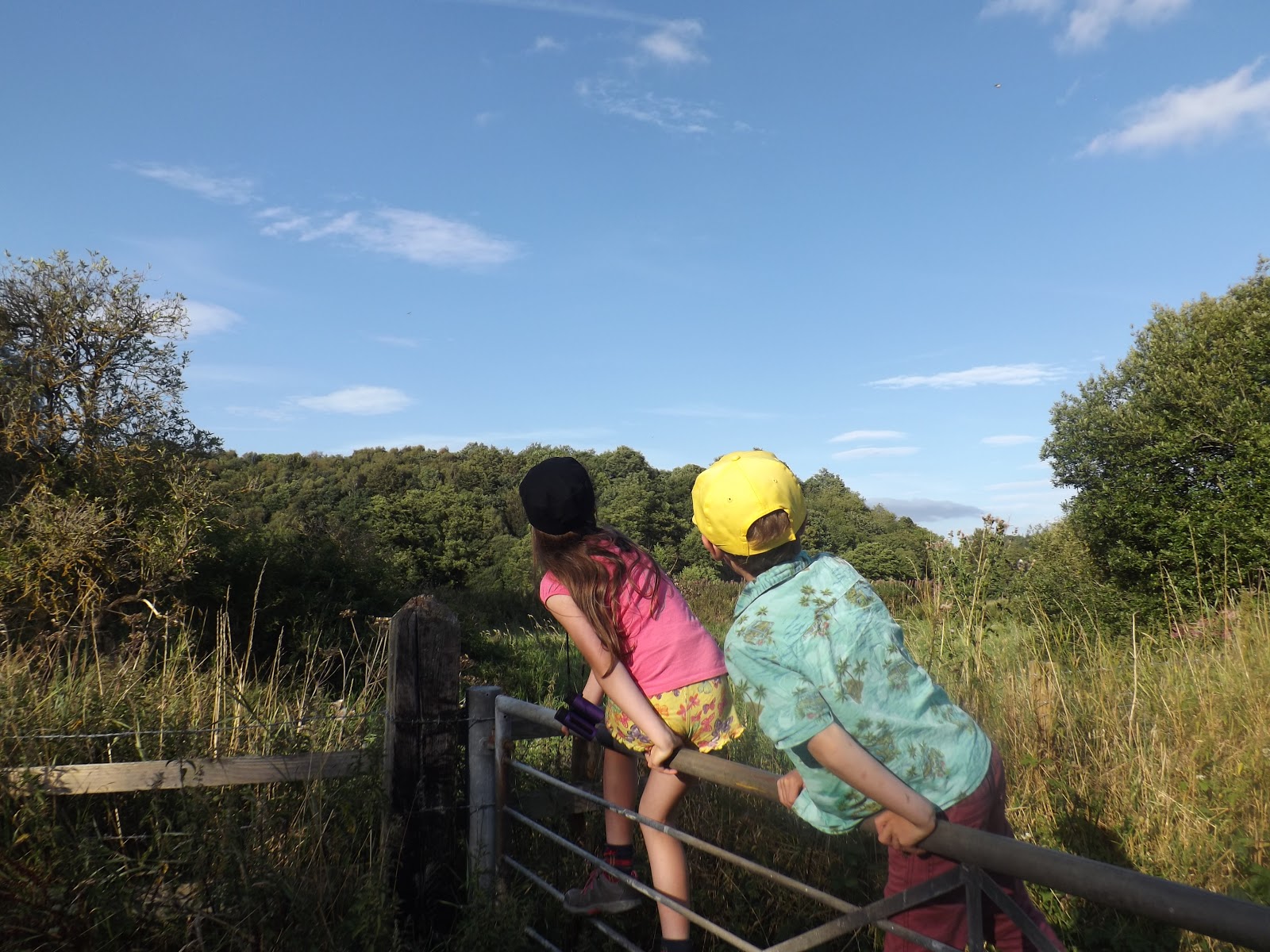
One thing that this trip really emphasised for me is the kind of wild creatures that really capture children's attention. I'm a very keen birder, and I'm trying to encourage them in that direction. Sometimes it's very successful. Last year they had wonderful trips to see a Starling murmuration and a harrier roost, where they saw their first Hen Harriers (a species they'd learned about at school as part of the skydancer project) before the sky filled with swirling snow and swirling Marsh Harriers. They also loved watching half a dozen Red Kites soaring together along the Derwent Valley, a trip my seven year old son had requested after seeing one of the birds painted on the side of a bus! They do well with those kinds of big spectacles. They also love any opportunity to get close to birds, as they did with the Kittiwakes on the Baltic and the Chaffinches we saw perching on the hide windowsill at Kielder. However, outside of these encounters it's hard to generate a lot of enthusiasm for the kind of birding that makes up a large proportion of my life, trying to id waders or ducks on a large pond or picking a warbler out of a leafy canopy. This is understandable, they are still young and that is a lot of effort for not a whole lot of reward if I am honest.


What my kids love is creepy crawlies, bugs, insects, minibeasts, and things of that ilk. They've been going pond dipping and rock pooling for years, and it does allow them to get really close to the creatures they are looking at, literally hands on in some cases. This was something we were very prepared for on this trip. The holiday lodge we were staying in is a few minutes walk away from the Cumbria Wildlife Trust's Barkbooth Lot reserve, a fantastic, quiet little nature reserve that combines woodland, a stream and an open fell top area with an excellent selection of butterflies and dragonflies.


 We spent several days there, armed with our new sweep net, butterfly net, pooters and collection jars. Before they went too wild, however, I gave them all strict instructions around the proper use of the equipment, including not to try and catch any of the rare and protected Fritillary Butterflies we might see, and to be careful around the ponds with leeches. They learned about teneral dragonflies and to be particularly careful with them. They learned to stick to the paths, such as they were through the ferns, and not to disturb the anthills that dotted the landscape.


As it happens, it was one of the quietest summers I've ever seen there for butterflies and dragonflies. The only large dragon we saw was a single Emperor, none of the other hawkers or chasers seemed to be present. Likewise, last summer I saw three different Fritillary species in one afternoon. This year I saw none, though my daughter was thrilled that the first butterfly she managed to catch was a Gatekeeper, a rare species that I got rather excited about.


 The lack of "rares" didn't bother the kids at all, and all day long I was being presented with minibeasts of all descriptions, with Shield Bugs, moths, Ladybirds and my first ever dung beetle. Some of them I could identify, but many others were photographed for future reference.


 A core part of my child-rewilding project has been the National Trust's 50 Things to Do Before You're 11 3/4, and I took an idea out of their Extra Messy edition. Each child had a jam jar, that they collected berries, petals and anything else they found to make a smelly potion (that was NOT for tasting!). Back at the lodge we added water, and then baking powder and vinegar to make bubbling smelly potions. This was great fun and I'll definitely try it again. We had a lot of debate about who had the best smelling potion, the nicest looking potion and the bubbliest potion and there was a surprising amount of variation on every count.


Of course the National Trust aren't the only ones who promote wild experiences for children, and it just so happened that we were away over the weekend of the RSPB's Big Wild Sleepout. my kids tried this last year with a tent in their back garden. They must have liked it because they ended up sleeping out there for almost a week. Last year I started getting into microadventures and wild camping though, and I wanted this year's to be a proper wild sleepout. So after a bbq dinner we headed up into the woods opposite our lodge to find a decent spot to camp. We'd been for a walk there earlier in the trip and found an excellent clearing near the top, but walking up in the dusk we settled for a smaller but just as serviceable clearing that wasn't nearly as far. There was a nice, flat grassy area for the kids to pitch their tent and a wide choice of trees for my hammock. Everybody slept really well up among the trees, giving me the confidence to try slightly wilder sites in future, and my older two are quite keen to give hammock camping a try, after climbing into mine the next morning.


 It was nice to be able to pack up in the morning though, and be back at the lodge ten minutes later for breakfast. Maybe in 2017 we'll just try hammock camping in the same bit of woods, and build up from there.

Wednesday, 27 July 2016

Butterfly fly away

Two days, 
two counties, 
three sites,
and a whole lot of butterflies!

I had actually been planning this trip for about a year now.  Last summer I was just getting into butterflies, and I discovered that Wingate Quarry in Durham had a colony of Marbled Whites, a butterfly I'd never seen but which looked quite special.  Then I discovered that Bishop Middleham Quarry, nearby, had a colony of Northern Brown Argus, another one I'd never seen.  It was late in the summer when I finally got down there last year, and not a particularly good day.  I made it as far as Wingate and found a single Marbled White before the rain started.  So it went onto the list for this year.  I got down there in mid-July for a day out with my mum.

The weather didn't look quite perfect, but certainly good enough; dry with sunny spells.  It turned out to be a lot better than that.  It was lovely and sunny at Wingate Quarry.

It clouded over and even threatened rain when we stopped at Castle Lake to look for Corn Buntings and I was starting to feel a bit doubtful about Bishop Middleham Quarry at that point but when we got there the sun came out again for a brief, glorious ten minutes, only to start raining when we got back to the car.

The butterflies were wonderful.  Wingate Quarry was alive with Common Blues (my first of the year), Meadow Browns and Ringlets, and on the small hill near the entrance I found a good half dozen or so Marbled Whites showing beautifully.  After seeing one last year, I'd declared this to be my favourite butterfly and seeing so many more only strengthened its position!


Blue butterflies come very close though.  They are so photogenic and bright.  Before this month I'd only ever seen a handful, so it's been lovely seeing them in much greater numbers.


Castle Lake was harder work.  The whole area seemed overrun with thistles and I couldn't get a clear view of what was on the lake itself with my binoculars, maybe because I didn't know the area.  There was only one significant target here though: Corn Bunting.  I'd actually had Corn Bunting on my life list for a while, as I'd identified a bird along Druridge Bay as one back in April 2014, right when I was starting to get back into birding.  I later took it off when I learnt a bit more and decided that it probably hadn't been what I'd thought.  I'd known about the Castle Lake birds since the start of the year but even though it was a potential lifer I'd been putting off a trip there until I could combine it with the butterfly hunting at the nearby quarry.  A good walk around the western half of the lake revealed nothing though, and I met up with my mum again on a hilltop and declared myself defeated.  We started back for the village when I spotted something sitting on a wall nearby.  A quick check with the binoculars and I was ticking my first Corn Bunting.  It's not the most spectacular of birds, but is rather nice in its own way and I was happy to finally see one and put that earlier error to rest.

On to Bishop Middleham Quarry, where the gathering gloom gave way to a brief spell of sunshine.  We didn't stop long here, because we were getting hungry and the weather didn't look promising, but it looks like a really lovely place to come back to for a longer walk.  Luckily there were plenty of butterflies near the entrance and I put my mother to work trying to spot one that looked like a Northern Brown Argus.  Several dozen Ringlets later, I realised that wasn't really working as a tactic.  Meanwhile I was carefully checking female Blues, though more than a little uncertain what I was actually looking for.  Then I realised that there were a lot of small butterflies flitting around that I hadn't really noticed at first.  They were brown, but significantly smaller than the Ringlets and had been overlooked by the both of us as probably moths.  I was pretty sure these were my Argonauts and when one stopped long enough for me to get a decent photo the white spots seemed to clinch it!  My third butterfly lifer of the year!


The next day was another nice, sunny day.  After a morning appointment with my work advisor I headed up for a new site for me at Cambois.  Someone on Twitter had told me about this when I was asking about his Grayling sightings, and it was just as well he'd given fairly detailed directions or I never would have found the place.  I walked through from Bedlington Station, a couple of miles towards the North Blyth coast.  Then in the middle of the Cambois Industrial Zone, where the power station once stood I left the road, pushed through some shrubs and weeds and climbed up a small bank.  At the top I was genuinely amazed.  The landscape just opened up in front of me with a long grassy path stretching north.  On my left were enough trees to hide the post-industrial landscape.  On my right was another bank leading up to a similar path on a higher level.

I've seen Grayling once before.  I was at St Bee's last summer on the Cumbrian coast, looking for Black Guillemots without my binoculars, a truly fruitless task!  Unable to see many of the sea birds, I instead borrowed my dad's camera and took photos of the many butterflies on the coastal path.  Most of them were Meadow Browns and Ringlets and it was only later that night in my tent that I realised that one of my shots was actually a really bad photo of a Grayling.  So it wasn't a lifer, strictly speaking, but it was definitely one I really wanted to see again properly.  And Cambois didn't disappoint.  After a few common species and some nice Damselflies, a Grayling settled on the path in front of me and started tilting its wings into the sun, behaviour I'd only read about.  It kept flitting away and then settling in more or less the same spot, though it proved very difficult to photograph.  I had a walk further along the path, where I saw plenty more Common Blues and my first ever Green Tiger Beetle.  Then before I left I climbed up to the top path and immediately in front of me I found a pair of Grayling settled together.

Funnily enough, the best views I had of this difficult butterfly were on my way home, when one kept flying just ahead of me and landing on the steel fence of the industrial zone and then on the kerb!

Tuesday, 5 July 2016

Sofa-birding


I'm going to sneak in one last blog post for 30DaysWild because I never got around to writing this one up and I rather enjoyed doing it.

This was from the Saturday after the referendum, when I was feeling a little low in mood and not particularly well either.  Various plans I'd had to go out had fallen through and to be honest I was feeling a little sorry for myself.

As beneficial as a day's birding would have been, I wanted nothing more than a day on the sofa catching up with Netflix.  But I also had to get in something for my 30 Days Wild, so I decided that I'd see what I could see out of my window.

Now, I really don't have much of a view out of my living room window.  Its an upstairs flat in central Newcastle and looks out onto a back alley and the roofs of the terraced houses in the next street along.  There's not a trace of any greenery.  It really doesn't look very good for birding.  It's certainly not like my last garden; a large, wild space backing onto a train line and then a golf course, birding gold!

So I wasn't too hopeful.  This started out as something of a throw-away gesture.  But I surprised myself.  Once I'd set myself this challenge I started paying a lot more attention to what was out there.  It started out strongly with some Swifts soaring high.  Herring Gulls were also passing over and wheeling around pretty regularly.  There were also occasional feral Pigeons flying straight over.

Then a Jackdaw came and sat on the chimney pots opposite.  A Carrion Crow found something to eat at the top of the neighbours' roof, dropped it and chased it all the way down the tiles.  Starlings gathered on the wires and descended en masse into the alley to scavenge among the bins.  A couple of fat Woodpigeons found a chimney to shelter on for a little while.  Magpies soared overhead.  As I got my eye in I was able to pick out the occasional Lesser Black-backed Gull among the Herring Gulls.

One of the biggest challenges was that I could only see a relatively small patch of sky, and often a bird would be past as soon as I saw it.  I learnt how to pick them out quickly, or I missed them when I waited to see them from the second window and they never appeared.


Pelagic cruise

Come sail with me
Come sail with me
Come sail away with me
You guys

Last Friday I went on my third boat trip of the year, and my first pelagic.  The trip was run by Martin Kitching of Northern Experience Wildlife Tours, and I'd booked through the Northumberland Wildlife Trust.  Martin turned out to be an excellent, friendly and knowledgeable tour and for four hours he took us out to sea and up the coast as far as Cresswell.

Unfortunately we didn't see any dolphins on my trip, and there was no sign of the Sperm Whale that had been seen on the Wednesday, though we did get a tantalising single large splash at or around where it had been seen, though nothing else was spotted there.  There weren't many skuas or shearwaters around yet either, still too early in the season.  These are what I'm really hoping to see, because I've only ever seen them as dark splodges far out at sea, but I've already got two more boat trips booked in September that hold more promise and I'm very tempted to book again with Martin.  We did get a handful of Manxies though, including excellent views of one shearing around not far from the boat.


We did get plenty of auks and gulls.  As is usual with these trips, we got excited at the first Puffin or Guillemot, and then pretty soon they were everywhere, though never in the numbers you get around the islands further north.  This was more than made up for by some of the best views of Gannets I've ever had, including several swimming on the sea.


We were also followed continuously by Herring and Lesser Black-backed Gulls, who would hang in the air just behind the boat.  One of the other passengers, David, noted a particular Lesser Black-backed Gull was constantly flying alongside us, landing, waiting for us to move on and then catching us up to repeat the whole exercise.


One of the absolute highlights of this trip was this scenery.  I'm a big fan of the Northumberland coastline, and it was quite special to see it from a whole new angle.  The weather added to the whole effect.  When we set off, the shoreline was black with storm clouds.  These slowly cleared and a narrow band of rain went over the boat.  On the way back south the sun was setting behind the cloud, giving some truly spectacular skies.  And it's not often you can see The Cheviot, Simonside, Spanish City and Souter Lighthouse at the same time!

Despite the lack of target species sightings, this was an excellent trip, and one I'd love to repeat later in the season.  I'm also rather tempted by the ten-hour version!


Wednesday, 29 June 2016

Healing Touch of the Wild

Last Wednesday morning I left a work programme workshop feeling rather anxious. There was no real reason for it, just that frustrating and faintly ridiculous feeling that something is wrong based solely on someone's innocent comment.  There was only one thing for it: spending the afternoon walking in one of my favourite parts of Northumberland, Druridge Bay.

I started at the excellent Drift Cafe just outside Cresswell, and then after a delicious scone it was on to Cresswell Pond where a couple of pairs of Avocets were still trying hard to breed and looking as elegant as ever.  A pair of Knots were also present, though it took me a little while to convince myself that they weren't the Curlew Sandpipers that were listed on the board for a few days earlier.  They steadfastly refused to fly and show me their tail patterning and I finally gave up when they fell asleep.


Druridge Pools was fairly quiet, the main highlight being some colourful Black-tailed Godwits, a Brown Hare on the far side of the Budge field and large numbers of Blue-tailed Damselflies all along the path.  The ponies were also looking rather lovely from the Budge Screen.  I do love seeing these ponies grazing on the Budge field, something so natural and right about that kind of land management technique.


Last time I was at Druridge Pools I was lucky enough to have a pair of Swallows perch right in front of the hide for some simply stunning views.  This time all of the hirundines kept perching on the fence to the right of the hide.  They were mostly Sand Martins with a few Swallows and looked lovely enough for me to wish I'd had a better view of them.

I had a quick look at the fields leading over to Chibburn Preceptory, hoping to maybe catch a Yellow Wagtail among the cattle there, but the grass in the fields was really long and didn't look too promising, so I headed straight up to East Chevington.


The wild flowers between Druridge Pools and East Chevington were one of the real highlights of my day.  I really don't know much about flowers, but I've learnt enough to identify the Bird's-foot Trefoil (an excellent butterfly resource) and Northumberland's county flower, the Bloody Cranesbill, some of which was starting to show the red leaves that give this purple flower its fantastically gory name.
I didn't stop for long at East Chev because I was started to get concerned about bus times home, but while I was in the middle hide I picked up a Marsh Harrier on the far side that circled around and then flew the whole length of the North Pool before dropping into the reeds.  Seeing these fantastic raptors in Northumberland still thrills me, even after seeing them in much greater numbers already this year at Blacktoft Sands and Leighton Moss.


Hurrying back to Cresswell for the bus I nevertheless had to stop when, passing Druridge Pools again, something flew straight across the road in front of me.  I raised my binoculars thinking "Sparrowhawk or Merlin?" only to find that it was a Cuckoo, one of my key target species left for this summer.  It was being harrassed by Meadow Pipits, and perched on a fence post on the edge of the dunes where I got the best views of this lovely bird I've ever had, and then flew north to another post further away.
I managed to make it back to Cresswell just in time for my bus home.  Heading back to Newcastle, I felt so much better within myself than I had when I first set out.  The natural healing touch of the wild had worked its magic again.

Cuckoo takes my year list to 217.


Thursday, 23 June 2016

Its...Its a Bio Blitz


And the man in the back said everyone attack
And it turned into a bio blitz
And the girl in the corner said Boy I want to warn you
It'll turn into a bio blitz

(with apologies to The Sweet)


Saturday night was my very first bio blitz, at the National Trust's Souter Lighthouse.  It was actually over a considerably larger area since the National Trust team there manage Whitburn Coastal Park and the Leas up as far as Trow.  It was a 22 hour bio blitz, starting at 8 pm on Saturday night and therefore obviously finishing at 6 pm on Sunday.  Unfortunately I had other (Fathers' Day) plans starting at about 10 am on Sunday morning, which would mean that I'd miss out on a lot of the fun, but with moth trapping, bat walks and Storm Petrel ringing happening overnight I was definitely up for a rare all-nighter. 

This was a really big commitment for me.  These days I'm very much early to bed, early to rise, something that's only really come about over the last few years, and I start struggling at about 10 pm.  Also, as I was travelling there by Metro, I really was stuck there until about 6 or 7 am on Sunday!  But I've never seen a Storm Petrel so that was a major draw.  I'm also finding myself increasingly drawn to moths and bat walks are always cool.


I started with a walk down the Leas before I got to Souter.  This section of coastline is one I've only discovered in the last year or two and I love it.  The twisty cliffs are so different to the long sandy beaches I'm used to in Northumberland.  It's also great for migrants and one of the best places I've found to watch Fulmers as they keep soaring up over the edge of the cliff right in front of you.  The birds were singing, the seabird colonies smelt magnificent and I found a rather faded looking Painted Lady.

I arrived at Souter Lighthouse at about 7ish, and met some of the team there.  Jason, Doug, Trevor and John were all really nice lads and great fun to knock about with for a while down there.  They were also really informative and supportive.  I got to have a wander around some of the areas of the coastal park that are normally off-limits to the public, and set small mammal traps with them through the shrubbery on one of the mounds and then around one of the ponds where I found one of my best sightings of the night, a Ghost Moth in the grass.  It was before 8 pm though, so didn't count towards the bio blitz.

When 8 pm came we started counting the bird species we could see, and then got the ringing nets for the Storm Petrels set up with another really nice, friendly couple of people, Andrew and Georgia, a regular ringer and ringing-viewer.


Things seemed to go pretty quiet for a while after this.  Andrew, Georgia and I stayed by the nets at the cliff top, while everyone else seemed to vanish off somewhere.  I occasionally got the feeling that maybe something exciting was happening elsewhere, but didn't have a clue where.  Maybe this is one of the problems of it being such a big site.  It turned out I wasn't really missing out on anything other than getting the moth traps set up.  


It was finally turning dark and Souter Lighthouse at sunset was looking rather lovely. The sky to the north was cloudy, though the nearly full moon to the south was shining brightly in a fairly clear sky.  We also managed to spot and identify three different planets, Mars, Saturn and Jupiter, though we couldn't make out any moons as it was still fairly light.


We managed to get the tape lure working for the Storm Petrels, and then fancying a bit of a change I had a drive around with Doug and Trevor, looking for Hedgehogs and Foxes, without any success.  They dropped me off with Jason, who was doing some newt surveying in the pond near where John was keeping an eye on one of the moth traps.  He'd caught what he called another Ghost Moth but which could well have been the one I'd found.

The newt survey picked up well over a dozen Palmate Newts, as well as leaches and lots of little fish that would be identified the next day when pond dipping.

This leads neatly on to one of the problems with my night-time adventure.  Because I wasn't there on the Sunday I felt like I was missing out on an awful lot.  I was there to set the mammal traps up, but not there to check them.  Likewise with the moth traps, which would be checked next day.  I was also missing out on bees, butterflies and dragonflies.  Next year I'm going to make a determined effort to be there for the full thing!

We all headed back to the bird nets at the cliffs where we found that nothing had been caught at all.  This wasn't really a surprise at this point, because all night people had been giving me reasons why we wouldn't catch any Petrels: it was still early in the season; the moon was too bright; the sea was too rough and loud; it was too clear.  There'll be other opportunities though, this year, and as I said at the time, even with all those factored in, my chances were a lot better than if I'd stayed in bed.

It was getting on for 1 am by this point, and it was looking like things would be relatively quiet until 6.30 by which time I'd have to be thinking of leaving, so I cut my losses and managed to blag a lift home with Andrew who, as luck would have it, was dropping Georgia off a few streets away from my flat.

Just as we were leaving, Andrew got a call from Jason at the nets, and we ran back, thinking he'd maybe got lucky as soon as we left him alone.  It turned out that he hadn't caught a Petrel, (they were at it until 3.30 and never got one) but a Pipistrelle Bat had flown into the net, so we got a good close look at that as he released it. 

Despite the relative lack of sightings, it was a fantastic night.  I met some lovely people and made some great contacts, and I'll definitely be back down there to try for Petrels again.  I'll also know who they are next time I see them out and about on the Leas, which is always nice.  Also, how many people can say they spent a night at Souter Lighthouse and saw a genuine ghost?


Monday, 6 June 2016

24 Hours Wild


 Truth be told, I was a little nervous about this one.  It was going to be my first time wild camping in England, rather than in Scotland where the law is a lot more on the side of the camper.  But I'd wanted to do this trip since the start of the year, and I've vowed to do things this #30DaysWild that pushes my limits and scares me a little. So I headed down to Wykeham Forest on the North York Moors with my hammock for 24 hours living wild in the forest.

I'd already put it off a couple of times, when the weather didn't look quite right or I had other priorities, but this time I had several days totally free and the weather looked absolutely perfect for a spot of raptor watching from the Wykeham Forest raptor viewpoint, so, large backpack on my back I set off for a long bus ride from Newcastle to Scalby, just north of Scarborough, a mere seven miles walk from Wykeham Forest!

One of the nice benefits of going somewhere for an overnight trip instead of going there and back in a single day is that there is a lot less pressure to get an early start.  When heading up into Northumberland or across to Cumbria I'm frequently out before 7am.  On Saturday I was a tad more leisurely and ended up on the 10:50 bus.  My planned stop-off at Scaling reservoir was knocked on the head when the bus started climbing up onto the North York Moors into ever thickening mist.  There wasn't much point going birding somewhere I wouldn't be able to see the birds, so I stayed on until Scalby, where the sun was shining and the sky was blue.


The route from the village to the forest was nice and easy to find because it followed a long-distance route, the Tabular Hills Walk, from "door" to "door" and was really clearly signposted. I have no idead where this path ultimately leads to, but it really helped to eb able to follow it.


It started with a really pleasant walk along a slow moving stream, with a Painted Lady butterfly leading me down it for a while and then a Sparrowhawk cut straight across my path and disappeared into the trees opposite.

The sun was shining, the birds were singing, and all was right with the world.  There were Orange-tips everywhere, maybe half a dozen Painted Ladies and more Diamondback moths than I cared to count.
 Then, something whirred over my head.  At first I assumed it was another butterfly, but when I managed to find it I discovered a damselfly, and not just any damselfly but an immature male Beautiful Demoiselle.  This is a damselfly I've wanted to see ever since I first heard its name and saw a drawing of it three or four years ago, and this was my first one! Not something I'd been expecting to see on this trip but very, very welcome nevertheless.
After the river, I had a mile or so to walk along a country road and then a short and very steep hike up Lang Gate, into the forest itself.  From there it wasn't too far to the first viewpoint, where I found some trees that looked suitable for hanging my hammock from.  I walked along to the raptor viewpoint, where disappointingly everything I could (almost) see was shrouded in mist.  This wasn't the weather I'd been expecting, and I started to get a little concerned that if the Sunday was the same I wouldn't be seeing many raptors.  I made myself some dinner, relaxed for a while, explored a bit and then settled down in a clear fell area just next to the viewpoint to try and see some Nightjars.

Unfortunately I failed to see or hear any Nightjars there, though I was treated to a fantastic roding Woodcock flying back and forwards over my head making that wierd little call they make.  It was already the best views I'd had of this usually secretive bird before he landed on a large pile of stones just two metres in front of me.  It was a chill and misty night, which may have kept the Nightjars away, or they might have been putting on a fine show elsewhere.  I'd seen several other birders earlier in the evening who must have been looking somewhere else.  At about 11 I headed back to the first viewpoint, where I put my hammock up in the dark, so as not to disturb the young couple parked up in the car park, who I guess were waiting for someone who never arrived.  It was the first time I've used my hammock without a tarp shelter over the top, which was really quite lovely.  You feel so much more out in the open that way, whereas with the tarp you are effectively in a well ventilated tent.  

I love my hammock.  It's so easy to set up and is really quite comfortable when you get it right.  This trip had another purpose: I'm hoping to contribute to Alastair Humphreys' Great British Summer Microadventure Challenge details here. A few isolated drops of water fell on my head, possibly from condensed mist in the trees above me but never enough to be a problem or to justify putting up the tarp cover.
The next morning was initially still fairly misty, but it soon cleared into a beautiful sunny day.  After a few hours of watching from the raptor viewpoint with a couple of very friendly birders from Leeds and York, we were rewarded with splendid views of  the first reported Honey Buzzard in the forest this year, doing its wing-clapping display flight and heading slowly down the valley past us before disappearing into the trees opposite. Later in the morning I got chatting to a couple who'd come up from Norfolk for a week.  Without these encounters I think it could have been a very long, lonely vigil there, but with them it was a thoroughly enjoyable experience.  The guy from Leeds told me that he'd made it his aim in recent years to see all 15 British birds of prey species, which got me doing a lot of working out on my fingers as to which ones he meant.  I'm pretty sure that with the addition of Honey Buzzard to my life list I've now seen all fifteen, with bonus points for a Red-footed Falcon.


I left them all to it at noon, to spend some time exploring the tree nurseries before I headed back for my buses home. I'm not sure what I expected the nurseries to be like, but they are absolutely amazing: field after field of tiny little trees that made me feel like a giant in a forest.   
They are all tightly packed together and stretch on for such a long way.  Different parts of the nurseries have trees at different stages of growth.  I guess its pretty obvious that this is where the big trees originally come from, I've just never considered it before or expected it to be quite on this scale.

 The nurseries are also a favourite with Turtle Doves, and I coule hear several purring as I walked around it, and finally managed to see a couple.  Another addition to the life list.  The final bird of note was a rather lovely Goshawk just as I was leaving the first viewpoint on my way home.

I'd allowed rather more time than was necessary for the walk back, as I got down the steep Lang Gate a lot quicked than I got up it.  This turned out to be a very good thing, because it meant that I had time to stop at the really rather lovely Everley Country Cafe on the way back for a chilled glass of limonata and a slice of lemon drizzle cake.  According to their visitor logbook they sometimes get Goshawk sightings from the cafe's garden, and I couldn't think of a nicer place to sit and look for one.  I'll definitely be back to try their scones and tea!

I got back to Scalby for 3:30, exactly 24 hours after I'd arrived there, feeling tired but very happy with my trip.